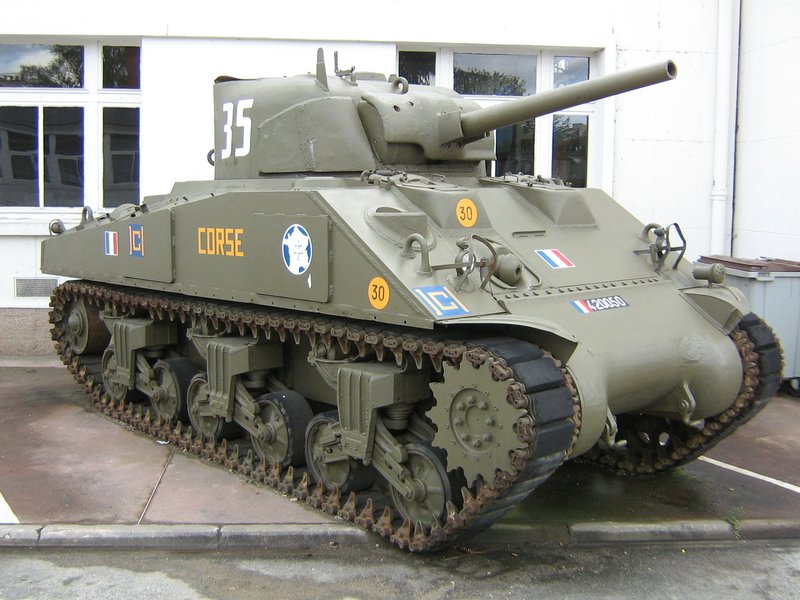
The M4A2 Sherman

The M4A2 model of Sherman was equipped with the General Motors 6046 engine, an expedient tank power plant design that combined two "off the shelf" GM 6-71 diesel truck engines that were “coupled together by means of a transfer case delivering the doubled power to a single driver shaft.” Together the twin engines developed about 400 horsepower. The M4A2 was produced in a "First Generation" version with 75mm gun. In May 1944, a "Second Generation" model with 76mm gun completely replaced the First Gen in production. M4A2s were intended to be distributed as Lend Lease, since the US Army had determined that its forces would use gasoline engines as much as practical. The figures vary somewhat, but US Lend Lease documents have it that the Soviets were shipped 1991 M4A2(75)s and 2073 M4A2(76)s. The United Kingdom was reported to have been shipped 5041 M4A2(75)s and 5 M4A2(76)s. Members of the Commonwealth known to have used British Lend Lease M4A2(75)s in combat during WW II include Canada and New Zealand. In addition, the British provided armored units of the Polish Government-In-Exile with some M4A2(75)s. The US Army is reported to have received 76 M4A2(75)s from the Brits on an emergency reverse Lend Lease basis to make up for losses suffered during the Battle of the Bulge. There is evidence that some fought with US units in the ETO starting in early 1945. Officially, France was shipped 382 M4A2(75)s, although it can be documented that they were issued a few more from US stocks that were not charged to Lend Lease. The US Marines are stated to have received a total of 493 M4A2(75)s, many of which fought in the Pacific Theater of Operations.


M4A2(75) Sherman

   
M4A2(75)    M4A2(75)

M4A2(75)s were manufactured by the Fisher Tank Division of General Motors, Baldwin Locomotive Works, Federal Machine and Welder, American Locomotive Company [ALCO], and Pullman Standard Car Manufacturing Company. The Ordnance Department made no distinction between "small" as opposed to "large" hatch M4A2(75)s, so officially, 8053 M4A2(75)s were produced from April 1942 through May 1944. Of that total, counting heads suggests that about 7053 units were manufactured in the original configuration characterized by glacis plates with 57° slopes and protruding drivers' hoods with "small" hatches. The earliest M4A2(75)s were built with drivers' hoods with direct vision slots such as shown on the Fisher M4A2 on the left, on display in London, Ontario. Testing revealed that the direct vision slots were ballistic weak points, and on 13 August 1942, the Ordnance Department ordered them eliminated from the design of the welded hull Sherman. The reconfigured drivers' hood castings were elongated and included additional periscopes in front of the hatches. The right-side image shows a Pullman M4A2 with the elongated hoods on display at the Australian Army Tank Museum in Puckapunyal. It is thought that all of the drivers' hoods used on all of the small hatch M4A2(75)s, both direct vision and elongated, were so called "narrow" drivers' hoods that were about 18 1/2 inches wide and were mirror images of each other.


M4A2(75)

The photo above provides a close-up view of a "small hatch" M4A2(75) with the elongated drivers' hood castings welded into the 57° glacis. Note the additional periscopes in front of the drivers' hatches. This example is part of the collection of the Tank Museum at Saumur in France.


M4A2(75)

An interesting variation of the elongated drivers' hoods was developed by Fisher at the request of the Government. In order to save casting capacity, these drivers' hoods were not cast but were assembled by welding. We refer to them as "fabricated." The fabricated hoods were designed to accommodate the standard "small" drivers' hatch castings. Current evidence suggests that the fabricated drivers' hoods were exclusive to Fisher M4A2(75)s. At present, our best guess is that Fisher began the transition from the direct vision drivers' hood castings to the elongated, fabricated hoods in November 1942 and used them until around November 1943 when they transitioned to production of large hatch M4A2(75)s. The example shown above is a December 1942 M4A2(75) on display in Chieti, Italy. Note the sharp angles of the fabricated drivers' hoods. Fisher also developed some other fabricated components to use in lieu of castings. These included the antenna bracket (1), the bow machine gun socket (2) and the headlight sockets (3). While it would appear that only Fisher M4A2s utilized the fabricated drivers' hoods, photographs and a few surviving Shermans indicate that Baldwin and Pullman used some of the smaller fabricated fittings on some of the their production M4A2s and M4s (Baldwin). For instance, earlier we showed a photo of a Pullman M4A2 at the Australian Army Tank Museum. It is an example of a non-Fisher M4A2 outfitted with a fabricated antenna bracket and bow machine gun socket.


M4A2(75)    M4A2(75)

The upper rear hull plate of the M4A2 is sloped and is installed with a series of horizontal bolts that secured the rear engine deck plate along with a few vertical bolts that secured an internal fitting for the twin radiators. All models of the M4A2 were built with grouser compartments accessed through oblong holes (1). These were blanked off with plates (2). Note the sheet metal exhaust deflector (3).


M4A2(75)

All models of the M4A2 were equipped with a dual muffler and exhaust system (1) which ran across the lower rear hull plate. Consequently, M4A2s did not have engine access doors in the rear like the other Sherman types. This example is missing its exhaust deflector.


M4A2(75)

The engine deck was designed with several removable plates. The engine could be accessed through "two heavy steel louvered doors" (1) mounted in the forward plates. First Generation M4A2(75)s had 7 fuel/oil/water filler points protected by armored covers. The two covers on either side of the engine access doors are unique to the M4A2 and can serve as recognition features. The forward armored covers protected the lubricating oil filler points for the left (2) and right (3) engines. The ones directly behind provided water to the left (4) and right hand (5) radiators. M4A2s were designed with a removable guard (6) to protect the lower rear of the turret from damage by "bullet splash."


M4A2(75) with large hatches


M4A2(75) Dry

Current evidence is that only Fisher produced the M4A2(75) with larger drivers' hatches. In late 1943, the Ordnance Department directed that all new production Shermans would be equipped with larger drivers' hatches as an essential safety measure. For the Sherman models that used the newly designed "rolled front plate" with the 47° 1-piece glacis, the "Freeze Date" is listed as "11/15/43" [Nov. 15, 1943]. Our best guess is that about 1000 of the last M4A2(75)s built by Fisher starting in November 1943 were manufactured with the 47° "rolled front plate" incorporating the larger drivers' hatches. However, these cannot be considered true 2nd Generation Shermans since they retained the so-called "dry ammunition stowage" of the original design in which the majority of the 75mm rounds were stored in more vulnerable positions above the sponson line. Thus, they were factory installed with the 1-inch applique plates (1) seen here to add a bit more armor protection for the ammunition bins located inside. We believe that the unit shown above was one of the first M4A2(75)s built with larger drivers' hatches. It was evaluated at the General Motors Proving Ground and is stated to have been Serial Number 27283 / USA 3035813 indicating November 1943 acceptance. Period photos show large hatch M4A2(75)s in service with the Soviets and the US Marines.


M4A2(75) Dry    M4A2(75) Dry

We are aware of but two surviving examples of the M4A2(75) with large hatches. The one on the left appears to be a former USMC Sherman, now on display at the People's Revolution Museum in Beijing. The cut-in-half example on the right is a Soviet combat casualty on display at the National Military Museum in Bucharest, Romania. For our research, we hope that we might obtain the Serial Numbers of these tanks at some point in the future. Counting heads suggests that a gun travel lock (1) was standard on all models of large hatch, 47-degree welded hull Shermans.


M4A2(76)W Sherman

M4A2(76)

As mentioned previously, the M4A2(75) was replaced in production by the M4A2 with 76mm gun starting in May 1944. The Fisher Tank Division manufactured 2894 M4A2(76)s from May 1944 through May 1945. In addition, Pressed Steel Car produced 21 M4A2(76)s with HVSS from April to May, 1945. The M4A2(76) was equipped with a redesigned turret, enlarged to accommodate the 76mm gun. A number of Ordnance documents added "W" for "Wet Stowage" to the M4A2(76) nomenclature to indicate that the tank incorporated a significant change whereby most of the main gun ammunition was relocated to safer positions in the floor of the hull and the ammunition bins included sealed chambers that were filled with a liquid "quenching solution." It was thought that if an ammo rack was penetrated, the "quenching solution" would be dispersed, and at least slow the progress of an ammunition fire in order to give the crew a few more seconds to escape. The British are reported to have received 5 M4A2(76)s as Lend Lease in the second half of 1945; that is, after VE Day. The Fourth Russian Lend Lease Protocol ran from July 1944 through 31 June 1945 and called for the delivery of 3000 M4A2(76)s. As it turned out, over 900 were cancelled with the end of the war. US Lend Lease documents have it that the Soviets were shipped 2073 M4A2(76)s out of the total of 2915 produced. The photo above is one of a series taken at the Soviet Proving Ground at Kubinka during evaluation trials, circa November 1944. In a number of documents, the Soviets identified their Lend Lease AFVs by the USA Registration Number. This example was listed as "3080862" indicating July 1944 production. Yuri Pasholok, author of the webpage [translated as] “Emcha With a Long Gun” reports that the first M4A2(76)s arrived in Baku on the Caspian Sea in late September 1944. Details are still a bit sketchy, but the Red Army did use M4A2(76)s in combat during WW II. The 1st Mechanized Corps is said to have been the first to receive the new “long gun” Shermans starting in October 1944. First combat appears to have occurred in late 1944. Soviet records indicate that units of the 9th Guards Mechanized Corps reported losses of M4A2(76)s starting 5 December 1944. Photo courtesy of Yuri Pasholok.


M4A2(76)W    M4A2(76)W

The photos above show the way the large drivers' hatches were mounted into a casting (Part Number E 8020) that spanned the width of the top front of 47-degree, welded hull Shermans.


M4A2(76)W

The engine deck details are more or less the same as on 1st Generation M4A2(75)s except that an armored cover (1) was added to the rear engine deck plate. With the adoption of the diesel engine, pressed metal labels were affixed near each of the armored filler caps to help the crews avoid contaminating the tanks with the wrong solutions. On several surviving examples including the unit shown above on display at the Canadian Tank Museum / Ontario Regiment Museum, the curved label directly in front of this armored cover is still intact and reads, "ENGINE OIL GAUGE." Perhaps an owner could enlighten us further, but we are assuming this was to check the oil level and that there was a dipstick attached to the inside cap. We have yet to come across any documentation, but the earliest it appears in a period photo of a unit with a known good Serial Number is September 1943. So, our evidence is that this new cover appears to have been added to some of the last small hatch M4A2(75)s built by Fisher and was standard on the company's large hatch M4A2(75)s and M4A2(76)s.


M4A2(76)W

Starting on 1 January 1944, Fisher was directed to replace the original sheet metal exhaust deflector with the new Barber-Colman type (1) seen here. Thus, some large hatch M4A2(75)s were factory installed with the B-C deflectors as were the M4A2(76)s produced up to March 1945. A "blanket roll rack" (2) was a standard item added to 2nd Generation Shermans. Spare track holders (3) mounted in fittings on the upper rear hull plate were also standard up until the changeover to Horizontal Volute Spring Suspension [HVSS].


M4A2(76)W HVSS    M4A2(76)W HVSS

Only three manufacturers continued to produce Shermans from the beginning of 1944 until the program was terminated in mid-1945 as WW II came to an end. The Chrysler Corporation designed the Horizontal Volute Spring Suspension [HVSS] system that increased the track width to 23 inches in order to improve the floatation properties of the original design VVSS suspension which had tracks that were only 16 9/16 inches wide. Chrysler made the transition to HVSS starting in August 1944. However, HVSS components could not be made available in suffficient numbers to Fisher and Pressed Steel Car until the beginning of 1945. While official documentation has yet to be found, best evidence is that all Sherman production from 1 January 1945 on incorporated HVSS. We calculate that Fisher produced at least 1299 M4A2(76)s with HVSS and Pressed Steel Car another 21. The example shown above is Serial Number 69132 (April 1945 acceptance) and is on display in Kelowna, British Columbia. It is one of the 300 (or 294 according to one source) M4A2(76)s with HVSS that Canada is reported to have purchased from the US in 1946 at the very reasonable price of $1,460.00 each. While 2nd Generation Shermans with VVSS stored spare tracks on the upper rear hull plate, those with HVSS stored them on the sides of the tank as seen here. Reports from the battlefield noted that the radiators of M4A2 and M4A3 Shermans were vulnerable to shrapnel and other types of combat damage. In late 1944, the Ordnance Department designed armored exhaust deflectors. Counting heads suggests that Fisher replaced the Barber-Colman deflector with the two-section armored deflector (1) shown here in March 1945. The armored first aid box (2) appears to have been factory installed by Fisher starting in April 1945. Photos courtesy of Alf Adams.
 

HOME